Like in many modern offices, my desk sat in an open-space room shared with engineers. I was the only designer, and proximity was the only logical way to keep the R&D team physically together.
I always preferred working at the office rather than at home, even after Covid when remote work became the new norm. Being around people meant more ad-hoc meetings (not always a positive thing), socializing over coffee, and more importantly having direct access to them if a lack of clarification prevented the work from moving forward. That was especially useful when the work in question was regulatory documentation.
Being new to the regulatory area in a health-tech startup is quite overwhelming, particularly at the beginning, when the structure is not clear and there are many unanswered questions. For the MDR compliance and FDA clearance, my role was to ensure that all documentation regarding human factors and usability was aligned with the standards.
I started by reading them multiple times, highlighting relevant sections for easier access, and creating a plan that changed more times than I care to remember.
Working with another colleague made the work slightly easier. The amount of documentation required for regulatory purposes was extensive: scripts, protocols, and reports for summative usability tests, Human Factor SOP, working instructions, and risk management documentation were some of the artefacts that needed to be addressed. Even though we brainstormed numerous times to handle all the administrative stuff, deciding and harmonizing the content throughout all the documentation was part of my job.
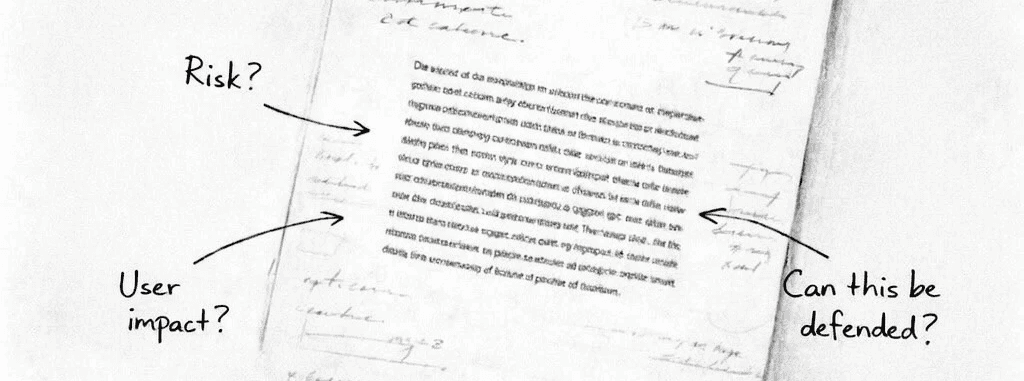
Many times I sat at my desk reading a document I had already gone through multiple times, trying to ensure that the information was presented clearly enough that, when the auditor scrutinized it, there would be no confusion.
At the beginning, it was difficult to feel fully confident about the quality of my work. I had never participated in an audit before and didn’t know what to expect. My instinct was to anticipate every possible question in advance, so I kept revisiting the standards, searching for examples that could guide the web-based application I was designing.
Luckily, I wasn’t completely alone in that process. An experienced regulatory colleague provided guidance when interpretation became ambiguous and acted as the formal approver on certain documents. But for others, the responsibility to decide, justify, and sign off was mine. That distinction shaped how I approached every page.
I was searching for certainty wherever I could find it.
The MDR and FDA submissions took years. It is a long process, with extensive back-and-forth with regulatory bodies, especially because the software was an innovative solution for the detection and characterization of seizures. The usability-related documentation was a tiny fraction of the required product validation evidence.
During that time, my role evolved from UX/UI design to full ownership of Human Factors and Usability. This realization did not come during an “a-ha” moment. It was a slow internal shift toward autonomy that felt like a natural progression of my work. There was no escalation path; only a path with multiple smaller trails that all led to the same goal: clearing a dense forest full of requirements, proof, and high-stakes risks.
Slowly, my attitude shifted from “is this good enough?” to “can I defend this if someone asks me?”
One of the largest documents I’ve ever co-authored, reviewed, and approved was more than 200 pages long. It was a summary of multiple usability tests according to the “non-binding recommendations” of Applying Human Factors and Usability Engineering to Medical Devices – a Guidance for Industry and Food and Drug Administration Staff.
With no prior regulatory experience, following the guidance to the letter felt like the most sensible choice. This guidance was the only reason a simple usability report turned into a “book”. A couple of times, I was told that no one would read this report and that those guidelines were just recommendations, so there was no need to follow them so strictly.
I like to think that the people who told me that had my best interest at heart and wanted to prevent me from wasting time. However, for a moment I felt alone and without reassurance. The truth was that there was no evidence that a lighter version of the report would suffice, so I chose a conservative path rather than risk receiving regulatory objections.
Looking back, I feel that this report was the first step in my transformation from UX/UI Designer to owner of Human Factors and Usability, a role with much higher stakes and quality standards. I was accountable for defending my decisions regarding a regulated product, and I had to carry that responsibility through submissions.
When submissions were accepted without requests for changes related to the usability, it wasn’t just reassurance; it was proof that taking ownership, thoughtfully and deliberately, had tangible impact on the product and the team.
My approach to everything (not only documentation) shifted from seeking reassurance to following what felt defensible. My beacon became the answer to the question: “Can I defend this if someone asks me?”
In the early days, I would spend time with engineers discussing UI elements. Almost every decision was made with regulatory constraints in mind. Choosing radio buttons instead of a dropdown when there were fewer than five options reduced human error, minimized clicks, and improved visibility – all of which enhanced usability and lowered risk.
With the new approach, I learned to set clearer boundaries. I continued discussing and listening to engineers, because they had a unique mindset and could provide excellent feedback. If they suggested something that decreased implementation time without lowering usability quality, I would agree to it. But if a design iteration required a more complicated implementation in order to reduce the usability risks, I would defend my decision and ensure it was followed.
It was a steep learning curve to understand which battles were worth fighting for and why.
I provided fewer unnecessary explanations, not because my opinion mattered more, but because there was no need to over-explain everything in order to gain approval. Ownership reshaped my personality and reduced my fear of accountability. I learned that it is sometimes worth allowing momentary tension in order to avoid lowering standards. It is okay to accept ambiguity, as long as there is a plan B and clear communication around decisions.
Perfection cannot be achieved on the first try, if ever.
Ambiguity is inevitable. Ownership forced me to grow into it. Looking back, it was about becoming durable, accepting the consequences of my decisions and moving forward anyway. –
– This article is part of the series I’m calling Designing in the Unknown, where I reflect on the realities of designing in a complex, high-stakes environment. In the series, I unpack moments, decisions, and tensions that shaped my work over time in the health-tech domain. –